Monday, March 31, 2014

Book Review: The Summer of Letting Go by Gae Polisner

The Summer of Letting GoThe Summer of Letting Go by Gae Polisner
My rating: 5 of 5 stars

Francesca “Beans” Schnell’s world has been falling apart ever since her little brother drowned. Her father seems to be hiding something, her mother can’t look her in the eye, her best friend is dating the boy of her dreams and worst of all, she hates herself as she feels she’s to blame for her brother’s death.

While trailing her father trying to get to the bottom of his odd behavior, Francesca happens to meet Frankie Sky, a boy who bears an eerie resemblance to her dead brother. But it’s more than that, there are also inexplicable coincidences that lead Beans to believe her brother’s soul might be living in Frankie Sky.

Gae Polisner’s prose is like poetry. It reads as if every word of every sentence is handpicked with precision creating a perfect flow like ocean waves. This book was so evocative, I smiled, I cheered, I cried. Francesca’s story is haunting, yet hopeful and every time a new twist of fate occurred, my heart stopped, waiting to see what it might mean. I loved learning about Saint Florian, Christmas Island crabs, and sand dollars. I loved seeing how throughout the book Francesca grew stronger and further away from that place in her past, and closer to letting go.

I fell in love with the characters in this book. So many readers will be able to relate to those characters with that air of sadness about them — when you feel so heavy inside, like you’re drowning, but have to continue to move and stay afloat on the outside — the Schnell’s, Mrs. Schyler, Mrs. Merrill. Lisette is a perfect best friend, and lovely, and I love that she doesn’t act like she’s beautiful even though she clearly is. I adore Bradley's, quirkiness and even Peter’s peculiarity.

Then there is Frankie Sky. Gae has written him so well…I picture him in my head perfectly. His voice is adorable and I’m sure will stick with me for a long time. I wonder if Gae spent a lot of time around 4 year olds while writing this because it seems so spot on. And I love his spirit, the spirit of a young boy, full of energy and adventure who believes himself invincible.

I read Gae’s first book, The Pull of Gravity, and her writing is even better than before (and it was beautiful before) — This storey even more beautiful and heartfelt. If this is what we should expect from Ms. Polisner in the future, I'm in.

This book will resonate with me for weeks, I can tell. It will make me take a closer look at the world, at chance occurrences, coincidences and karma. I try not to live in the past and to live life profoundly and passionately like Frankie Sky, but sometimes I still need reminders, as I’m sure we all do, and this book as given me one.

Do yourself a favor and buy this book. You won’t regret it.

View all my reviews

Thursday, March 27, 2014

#HighSchoolTaughtMe

This hashtag is trending on Twitter today.  I like to scroll through and read what people write under the trending hashtags, sometimes I like to participate. As I read through #HighSchoolTaughtMe, I grew very sad about our youth's perspective on high school, and their lives in general.

Little do they know that when they respond to these hashtags, they are giving us a  glimpse into their view of the world. And though it's only 140 characters, it says a lot.

This is what some of them said about #HighSchoolTaughtMe:

  • that many teachers do more of the parenting than some actual parents do.
  • to cheat in exams.
  • that even the ones you look out for the most could turn their back on you.
  • it's okay if you're unhappy and completely miserable, so long as you have good grades.
  • that people will like you only if you're hot & popular.
  • some people are only going to be nice when they need you.
  • that most teachers don't care, they're just there to get paid.
  • that if you dont have stunning looks or you're not good in a sport than you're a nobody.
  • that I don't have a right to my opinion.
  • that sophomores post nudes.
  • how to hate people.
This is sad, yes? It seems to me that as adults we've gone wrong somewhere to make our children feel this way.  Behave this way. Perceive their world in this way.

Don't get me wrong, They weren't all negative, there were a few positives, like these:
  • that we should be happy,we need to be happy, we deserve to be happy .
  • that no one's opinion but your own is important in the end.
  • to be responsible and free at the same time. How to have fun yet how to not fail my parents.
Um, yeah, the positives were hard to find.

I can't say I blame these kids. In many ways, our public education system is struggling.

Teenagers deal with crap at school every day - drama, peer pressure, violence, bullying. Top that off with those that have the added pressures of sports, music or other activities, then homework on top of that. It can be stressful. Think how you felt at that age, how all your problems seemed like the end of the world. I know from personal experience that the school systems don't know how to handle some of today's teen problems.

In some ways, schools feel like prisons, with on sight cops, drug testing, drug sniffing dogs,  students wearing badges or picture IDs, random sweeps for drug paraphernalia, security cams. I'm not saying these are bad ideas. I'm sure in some areas security like this is necessary and I'd much rather have my kids be safe than me be sorry. But I can understand how a child could feel like an inmate in a school that takes those times of security measures.

Then we have the state of the facilities themselves. 44% of public school principals reported that problems with the school buildings themselves interfered with student's education. Heating and air condition, which I can attest to. I remember when I used to volunteer in the elementary school, the rooms were either freezing or like a sauna, no happy medium.  Size and configuration of the rooms also appeared to be a problem. And then there are the portables. These seem to be a major problem, from noise control to air quality to their overall physical condition, these seem to be a major interference in the education process.

I'm not going to blame the teachers here. I believe teaching is one of the most unappreciated professions on the face of the planet. Yes, there are bad ones. Yes, some don't know their subjects. I read that less than 15% of Math, English and Science teachers have neither majored in nor received a certification in those subjects. However, more than half have a master's degree or higher.  Not bad. Pupil teacher ratios are also good. Luckily we have more teachers in the country, so we have about 16 students per teacher. YAY!

Getting back to these unhappy children...especially the one who stated teachers act more like parents than parents...sigh...there are the kids that deal with shit at home. I know kids with parents who are addicts, who live with other family members. Kids from broken homes, which as mainstream as it is these days, still affects them profoundly. You don't know what else goes on behind closed doors, they could be dealing with abuse, whether it be verbal, emotional or worse.

We need to protect all these kids -  these kids who have it bad at home, these kids who have it bad at school, who hate the learning process for one reason or another. We have to let them know that it's not that bad. 


There are over 3 million high school dropouts annually. That number has gone down in the last few years, but still, 3 MILLION!?! 

 These kids won't go to college. Many will be teenage moms. Half the people on Welfare are dropouts. These are also our future criminals! 75% of crimes are committed by high school dropouts.

This is our responsibility as a society isn't it? To make sure these kids graduate? The signs are all there. These are the kids who skip school, who  do poorly in class, who get in trouble, who have obvious trouble at home.

What can we do? According to the Parents Association we can do this:
  • Arrange for help making up missed work, tutoring, placement in a special
    program or another school.
  • Help with personal problems and/or arrange for professional help.
  • Help them schedule work and family obligations so there is also time for school.
  • Help them understand the choices they make - marriage, parenting, failing, behavior, suspension, expulsion - and how those things can disrupt their ability to finish school.
  • If a student becomes pregnant, help them find school and social programs to help meet their needs.
  • If all else fails, help them find a GED program and encourage them to stick with it until they finish.
But here's where I started.


Never live in fear of failure, true friends are the ones that are there when things suck, and nothing lasts forever.


Wednesday, March 26, 2014

Just how difficult is it to write a book?

This was posed to me last night, and a totally legit question. I know that many non writers often wonder, because maybe  they'd like to try their hand at it because they have an idea that's been nagging at their brain for some time. If they have that much, that's good because of course a book has to start with an idea.

An idea can come from anywhere. They have come to me from big events in my life and fleeting moments, newspaper articles and simple phrases. Sometimes the ideas are big and sometimes all I have is an opening line, a character or a title and I have to work from there.

Once you have your idea, you can either outline it or just start writing. I tend to do the latter. I just write until I can't write anymore. I"m called a "panster" because I write by the seat of my pants. This is the first draft of my novel.

By this point, many people who start writing a book have already given up. You have to be determined, motivated, and diligent to stick with writing a book from beginning to end. It's not easy. Things will get in your way -- job, kids, time, life in general. If you really want it, and really think you have a story to tell, stick with it.

In the second draft I deal with the sticky parts. Usually the sticky parts for me are the details, developing characters and places, figuring out the storyline in what us writers call the "murky middle" and well, *cough* the plot. I have to make sure I actually have one. I've had to at this point add characters into the book, cut thousands of words and add 10s of thousands of words.

Then there are usually a couple more drafts.

For me, editing comes next. I have a couple friends who I think are great editors. their work (editors can be wrong too you know, plus, they're all proper and shit and sometimes you don't want to be proper and shit).

Much better than me (though I see they don't know their lay, lie, lying, laying either). So I have them go through the manuscript and find my mistakes.  I am doing all my corrections hard copy now. I've proven to myself that if I just have them track changes on Word, I get lazy and don't really check them. Having them correct on a hard copy actually makes me read the entire manuscript again and even check

Next step is to get Beta Readers. These are a group of people to read your manuscript and give feedback. I like to choose a variety of people. My editor friends give me feedback as well, so they kind of count. I gather up a couple writer friends who can usually give me an idea about the plot, storyline and character development. Then I grab a couple people who are strictly readers who give me a blanket idea of how the book worked. Did they like the story? The characters? Were there any problems? If so, what were they? Were there any questions left unanswered?

I do another rewrite based on the information I've gathered from my Betas. Now, keep in mind, your Betas are giving you opinion and you may not agree. Change what you feel needs changing and toss the rest away. However, if they're all saying the same thing, you should probably listen. When I had Betas read my last book, Dissected, none of them liked my protagonist. So in my rewrite I had to make her more sympathetic and likeable.

After the rewrite I'll give it back to at least one editor for copy editing again. With all those new words in there, there are bound to be grammatical and punctuation errors.

I may give it a couple more reads for good measure, just to make sure it's as publishable as can be. The voila! You have a book with which you can either start querying agents or indie publish.

This is just the basics. You should also brush up on writing tips, like don't use too many adverbs, exclamation points or ellipses...crap like that. There are a ton of great books on writing out there and of course, the almighty Google.

What is your process? Do you have any questions or comments? Feel free to leave them. I try to respond to every one.


Tuesday, March 25, 2014

Setting deadlines and other authorly stuff


I've decided if I'm ever going to complete this book, A Tattered Life (still not sold on the title), I have to set a deadline for myself. A couple weeks ago I realized I had not finished writing a book for two years when I completed Dissected. I've started many projects, none of which have come to fruition.

I have approximately 26k in on this novel. I'm figuring most of my young adult books hit at about 50k, so I'm about half way there. I've set myself a deadline of June 30th. That gives me 3 months, which I think is realistic.

However, I'm also redesigning my website, which I want to launch soon, and that is taking up part of my time. I'm about half way done with that as well. I have a goal of launching it on my birthday, which is April 11th. For now, that is the plan. It may not happen that fast, so I'm not making huge announcements about it. It will be a completely different design and brand than I've been using. It's time for Megan to grow up.

Last thing, I was interviewed by Ethan Pariseau for his podcast, Xposing Me. He talks to people about experiences they feel have changed their lives. Give it a listen at here


Monday, March 24, 2014

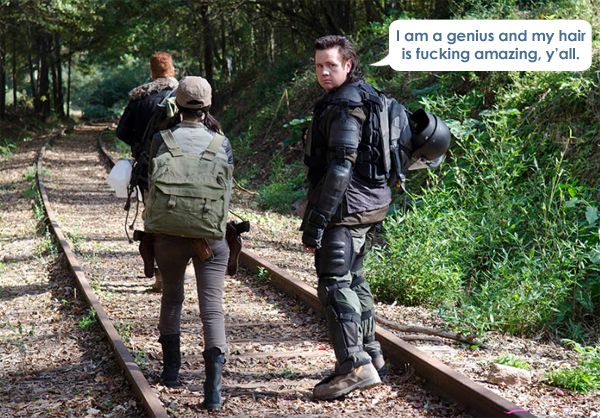
The publishing path is kind of like the road to Terminus

Yeah, so you're a writer working your way to this great unknown, but you know it's supposed to be wonderful. Terminus! *cough* I mean, publication. Yeah, and you're among others trying to reach the same goal. Some of them falter along the way. They get eaten up by metaphorical zombies in the form of self doubt, rejection, time and lack of motivation.

Zombies are the devourers of motivation.

The path is long and hard. Sometimes you have to kill Zombies on the way. It's not easy.

Sometimes you have to kill metaphorical "bad people"  that get in your way like plot holes, bad story lines, and flat characters.

Then what happens when you get to Terminus *cough* I mean publication? You really have no idea what you're getting yourself into. You feel relief, yet, something is still amiss. Yes, your publisher is really just a cannibal who will eat your soul.

I'm kidding. It's not that bad. Now there are people out there willing to prey on those who have given up on traditional publishing. They are the cannibals. Do your research before going indie. It doesn't cost all that much to self publish these days.

So, I reserve cannibal for the real predators out there, but the publishing industry can be a brutal reality, not unlike living in the zombie apocalypse, but you can do things to make the best of it.

These are things I've learned.
  • Most publishers do NO marketing for you after sending the book out to media unless you are already a name or you've written a series and they can see dollar signs in their future. I was very proactive in my own marketing, so mine did a wee bit more, but not very much.
    •  Be proactive and give them ideas, they may jump on board. If they don't, do research as to how to best get your book into people's hands without breaking the bank. Information is out there, you just have to find it.
  • Some editors are not very communicative.
    • If you are waiting for answers on your contracted book, bug them. If you are waiting for answers on an uncontracted book, give them their alloted time (if it's an option) check in and see what they thought. If they don't respond, move on. You don't have time to waste, because...
  • The process is painstakingly slow. Once you sign your contract, expect your book to come out 18 months to 2 years later.
    • There is nothing you can do about this. You must learn patience. If you have to stay all night in the trunk of a car while a herd of zombies passes by, you do it, no questions asked.
  • Don't think that having a great working relationship with your editor means you will work with them again. Sad, but true.
    • You love your editor, I know, but sometimes their house gets absorbed, sometimes they don't want your second book, sometimes shit happens and you don't get to work with them again. Keep their contact information though. I think it's perfectly acceptable (at least I hope so and if not someone should correct me) to contact and ask them if they'd like to see some future work.
  • It's okay to fire your agent. 
    • Sometimes these relationships aren't symbiotic. I know authors on their 2nd or 3rd agent. Find someone you click with. I know it's hard not to jump on the first person who takes you and if you feel you need to go ahead. But if you feel like they aren't doing your work justice, talk to them. If that doesn't work, you are perfectly in your right to terminate the relationship.
  • Getting a first book published doesn't automatically mean getting a second book published.
    • Yeah, the second book is the hardest from what I hear. I was agentless and didn't want to wait 2 years for my next book, so I went rogue. That may not be the answer for everyone. Do what is right for you.

Good luck on your journey to Terminus, I mean publication. I hope your experience is a rewarding one, as I truly believe mine was, and not full of metaphorical zombies, bad people, and worse yet, cannibals.

My Dad. He's awesome.

John Messina, Personal Injury Attorney

Total Pageviews